


Liposomal Technology
The Discovery of Liposomes
Liposomes were discovered in 1964 by British hematologist Alec D. Bangham at the Babraham Institute in Cambridge.
He found that certain lipids can form vesicles (small bubbles), which he termed liposomes.
He discovered them while studying phospholipids under an electron microscope using the negative staining technique.
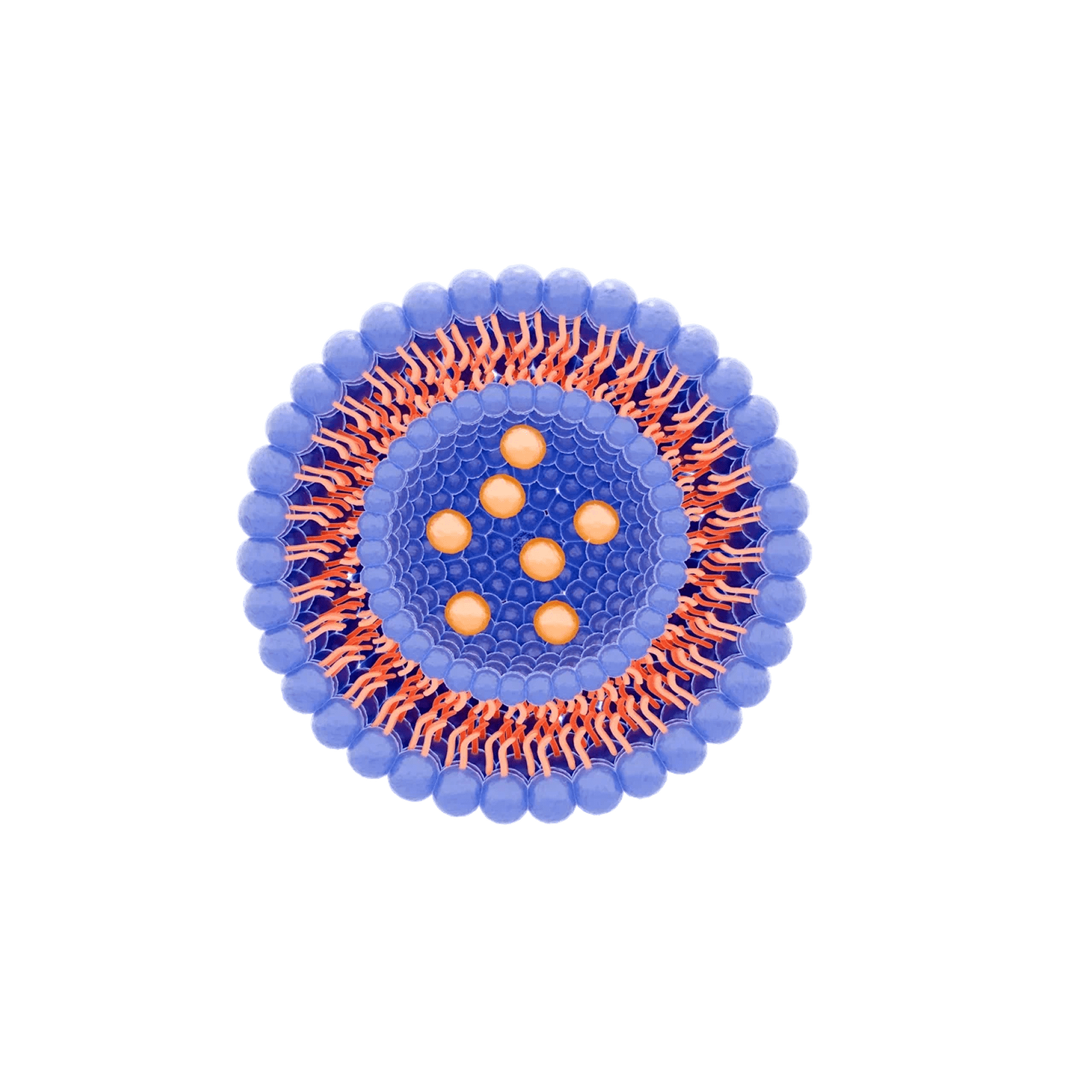
Liposome vs. Exosome — What Is What?
Human cells: 10 to 100 µm
1 µm = 1000 nm

Liposome
Ellipsoidal shape,
30–150 nm
Ellipsoidal shape,
30–150 nm
Outer and inner layers consist of polyhydric alcohols, phospholipids, and sphingolipids (molecular head groups).
The middle layer consists of the tails of phospholipid and sphingolipid molecules, forming a kind of interwoven layer.

Vesicle: 30–150 nm

Exosome
Spherical shape,
30–150 nm
Spherical shape,
30–150 nm
Bilayer shell composed of hyaluronic acid + cyclodextrin


Uniqueness of Liposomes
The similarity of plant phospholipids to human phospholipids enables them to integrate into cell biomembranes and blood lipoproteins, thereby helping to prevent a wide range of potential pathological processes.
Liposomes are artificial phospholipid vesicles with a range of unique properties that make them especially valuable for the delivery of active substances:

Biodegradable

Do not induce antigenic reactions due to metabolic characteristics (macrophages “do not recognize” them; size < 70 nm).

They protect the encapsulated compound from the destructive action of plasma enzymes.
They reduce the toxicity of encapsulated substances and prolong their action in the body.

Delivers active components directly into the cell.
Liposomal Technology
The components form an ellipsoidal liposome structure ranging from 50 to 150 nm in size, ideally suited for penetration into cellular membranes.
Our liposomes are produced using an ultrafiltration method with membrane filters of decreasing pore size. This process ensures a high degree of purification and the creation of nanocontainers for targeted delivery of active substances.

© All rights reserved. Beraderm.
Beraderm LLC
Primary State Registration Number (OGRN): 1257700208501
Russia, 115280, Moscow,
19 Leninskaya Sloboda St., Premises 62/1
19 Leninskaya Sloboda St., Premises 62/1

